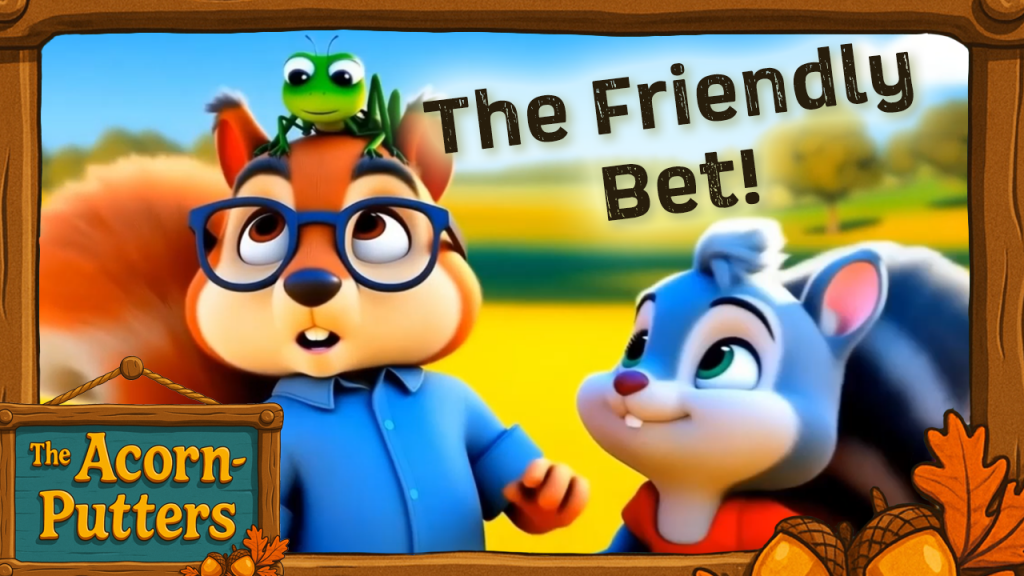
In our latest Acorn-Putters episode, Hazel and Scamp take on a bet to avoid screen-time for an entire week. In this “No Screens Challenge” they trade screens for outdoor play, imagination, and real-world discovery. The heart of this episode is summed up beautifully with the Jumble Jungle word “Discover.” But beyond the fun and adventure lies an important message for families: how we talk about and use screens really matters for young children’s development.
Let’s break down what experts say about screen time, how it can be used well, and why creativity and play, like discovering in the garden, are so powerful for little learners.
🌟 Why Too Much Screen Time Isn’t Ideal for Young Kids
Screens are everywhere. But research helps us understand that excessive screen time, especially for young children, can be linked to developmental challenges.
Studies have shown that higher total screen exposure in early childhood is associated with lower academic performance later on, including reading and math achievement on standardized tests. Each additional hour of daily screen time in young children has been linked with roughly a 9–10% lower chance of higher test scores in elementary school subjects like reading and math. (You can see sources of the studies here.)
Excessive screen time has also been connected to issues ranging from attention difficulties and language development concerns to less physical activity and poorer social engagement. (Source: MDPI.)
Experts often point to the value of limiting non-educational screen time for kids under age 5, both to support healthy development and to make room for play and exploration that build cognitive, emotional, and social skills. (Source)

📚 Screens Can Still Be Positive When Used Well
All screen time isn’t the same. Research shows that purposeful, educational screen use especially when shared with adults or siblings can support learning and even creativity. (Source)
For example:
- Using apps or videos that encourage problem-solving, storytelling, or creative expression can boost digital skills and creativity.
- Family viewing and co-watching a learning video together turns a passive activity into an interactive discussion.
Many child development experts stress that how screens are used and who children watch with is at least as important as how much screen time they have.
🎨 Fun and Creativity: The Heart of True Discovery
One of the things kids need most, especially in preschool years, is open-ended play. This is play that doesn’t have a right answer or a rigid structure, but instead invites curiosity, imagination, and problem solving.
In this No Screens Challenge episode, Hazel and Scamp:
- Step outside into nature
- Water the garden and explore the environment
- Connect creatively with each other
- Engage in imaginative thinking, like building a boat to play with outside
These kinds of activities help children develop:
- Creative thinking
- Problem-solving skills
- Social skills through play
- A sense of wonder and discovery
All of these activities (quiet exploration, unstructured play, and shared experiences) are the kinds of activities that research suggests are foundational for healthy development.

🧠 The Jumble Juggle Word: Discover
You might remember the Jumble Jungle puzzle in the episode, the scrambled letters that spell DISCOVER.
That’s more than just a fun word game. The episode uses “discover” as its theme to remind families that adventure doesn’t always come from screens, but instead it comes from curiosity, exploration, and paying attention to the world around us.
Whether it’s noticing how a flower grows, wondering what an ant is carrying, or inventing a story from a stick and some leaves, discovering teaches children to observe, ask questions, and use their imagination. All of these are essential skills for lifelong learning.

🧡 Final Thoughts for Parents
Balanced screen use, such as one that favors interactive, educational experiences with guidance from adults, can be part of a healthy childhood. But it’s equally important to offer plenty of opportunities for screen-free, creative play and shared exploration. When children are given space to be curious and imaginative, they don’t just play, they discover.
That’s the heart of why Hazel and Scamp stepped outside on this episode. It’s also a reminder that often the richest learning happens not through a device, but through the world right outside your door.

Energetic, fun, curious, and loving – Hazel Acorn-Putter can’t wait to share her adventures with you.